
Uganda’s 12th Parliament: Jacob Oboth-Oboth, the Unfinished Debate

Updated: Jul 2

Uganda’s Parliament has entered a new chapter, but the country waiting outside its chambers remains largely the same.
The economy continues to expand while many households still struggle with poverty.
Hundreds of thousands of Ugandans enter the labour market each year searching for opportunity in an economy where formal jobs remain limited.
Hospitals continue operating under pressure, schools still lose learners before completion, and corruption remains one of the country’s most persistent public concerns.
Across rural Uganda, climate shifts increasingly affect agricultural communities whose livelihoods still depend heavily on subsistence farming.
These are not made-up policy discussions. This everyday life.
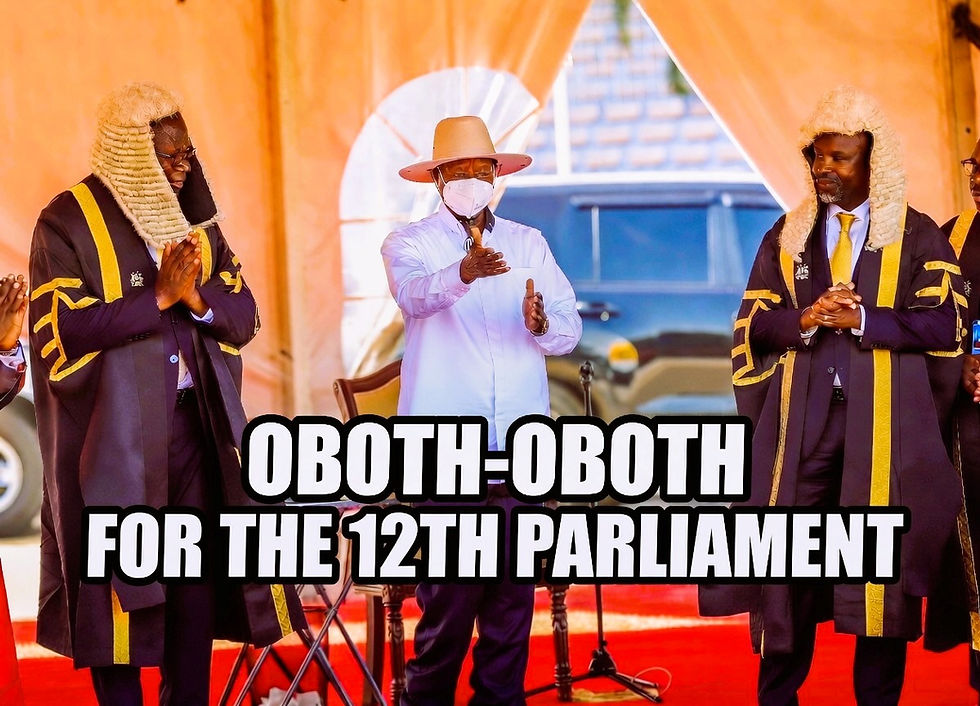
When Jacob Marsons Oboth-Oboth took oath as Speaker of Uganda’s 12th Parliament, the momenttherefore represented more than institutional transition.
It marked the beginning of another parliamentary cycle at a time when public expectations increasingly revolve around delivery rather than debate.
The previous Parliament unfolded during one of the most politically charged periods in recent Ugandan history. Sovereignty debates, political tensions, governance controversies, sanctions, public scrutiny, and competing social media narratives placed Parliament at the center of national conversation.
The new House now inherits that legacy.
Whether it can move beyond it may define the political memory of the 12th Parliament.
During his remarks after taking office, Oboth-Oboth outlined seven pillars that he said would guide his leadership: accountability, evidence based debate, transparency, proactive oversight, people centered legislation, institutional responsibility, and result oriented budgeting.
His words carried unusual simplicity.
“The speaker’s chair is not a throne, it is a servant’s post.”
The line immediately resonated because it arrived at a moment when many Ugandans expect institutions to feel closer to ordinary citizens and further from privilege.
The challenge ahead is transforming that aspiration into reality.
The Lawyer from Tororo and the Long Road to Parliament
Jacob Marsons Oboth-Oboth enters the speakership with a career built less around political theatre and more around institutional experience.
Born in Tororo District in eastern Uganda, he pursued law before entering public life and later rose through parliamentary and ministerial responsibilities. Over the years he served in government positions linked to defence and internal affairs while building a reputation centered on legal discipline and administrative work.
His rise contrasts with more populist political journeys.
Oboth-Oboth has largely been viewed as a technocratic figure shaped by institutional experience.
That profile may partly explain why the National Resistance Movement eventually consolidated support around him.
A wave of withdrawals swept through the ruling party camp after seventeen aspirants stepped aside from races for Speaker and Deputy Speaker, effectively paving the way for Jacob Oboth-Oboth and Thomas Tayebwa to emerge as official NRM candidates.
The decision followed discussions within the party’s Central Executive Committee chaired by President Museveni at State House Entebbe.
The withdrawals reduced internal competition and projected party cohesion ahead of parliamentary voting.
Political endorsement may open the door to office, but public confidence is earned through leadership, delivery, and institutional trust.
That challenge begins immediately because the 12th Parliament inherits pressures that extend far beyond legislation and parliamentary procedure into the everyday realities facing Ugandans.
Jacob Oboth-Oboth Sworn in as Speaker of Uganda’s 12th Parliament: The Weight of Inheritance
Every Speaker inherits more than the office. Jacob Oboth-Oboth steps into Parliament after a period that generated unusually strong public discussion around the institution itself.
The transition follows the parliamentary era examined in FTN’s news feature Anita Annet Among: The Girl Who Escaped Tradition and Reached the Peak of Power, which reflected on the remarkable rise of Anita Among from hardship in eastern Uganda to the peak of political leadership while also examining the scrutiny, debates, and controversies that shaped the later years of her tunure.
Among’s tenure unfolded during the Anti-Homosexuality Act, sovereignty bill debates, public accountability discussions, sanctions, political rivalry, and wider questions surrounding Parliament’s public image and institutional identity.
For supporters, it reflected firm leadership during one of the country’s most politically demanding periods, while critics viewed it as a tenure increasingly shaped by controversy, scrutiny, and competing narratives.
History may ultimately remember it as both.
Oboth-Oboth therefore inherits more than office or parliamentary procedure.
He steps into a House carrying public memory, unresolved debates, and rising expectations from citizens who increasingly appear less interested in personalities and more focused on outcomes.
Employment, healthcare, education, accountability, and economic opportunity now sit alongside legislation as part of Parliament’s wider responsibility to the country.
Uganda’s Economic Reality Is Already Knocking on Parliament’s Door
Uganda enters the 12th Parliament carrying structural pressures that have developed over many years.
Despite economic growth, poverty remains a major challenge.
According to the UNDP Multidimensional Poverty Index 2023/24, multidimensional poverty continues affecting millions through overlapping deficits in healthcare, education, housing, nutrition, and living standards.
Modern poverty increasingly extends beyond income.
Can households access healthcare?
Can children stay in school?
Can families secure electricity, clean water, and stable livelihoods?
These questions increasingly define development itself.
Uganda's Youth unemployment adds tangent of urgency.
Uganda possesses one of the youngest populations globally, creating both enormous opportunity and significant pressure.
Estimates suggest between 400,000 and 800,000 young Ugandans enter the labour market annually while formal employment opportunities remain limited.
Many therefore turn toward informal activity.
According to the International Labour Organization Uganda labour profile, the informal economy supports a substantial share of livelihoods and employment across the country.
While this sector keeps communities economically active and provides income for millions, it also creates structural limitations that affect long term development.
A large informal economy reduces tax revenues, limits productivity growth, and makes long term economic planning more difficult because much of the activity remains outside formal systems.
This is the economic reality the 12th Parliament now inherits as it seeks to balance growth, employment, and national development priorities.
Regional comparisons reveal the scale of the challenge more clearly.
Rwanda spent years investing in administrative efficiency, digital governance, and formalization systems aimed at gradually bringing more economic activity into structured channels.
Reforms around electronic billing, e-filing, e-payments, and the wider integration of small and medium enterprises helped expand the tax base while improving compliance and institutional trust.
Rwanda’s broader digital push has continued through initiatives such as interoperable payment systems and national digital infrastructure designed to make participation in the formal economy easier and more accessible for ordinary citizens.
According to the International Growth Centre, Rwanda increased tax revenue from below 10 percent of GDP in the early 2000s to about 17 percent by 2018 through tax modernization and broader inclusion efforts.
Kenya approached the challenge from another direction by focusing heavily on financial inclusion and digital entrepreneurship.
The country expanded mobile money ecosystems, technology driven enterprises, and support mechanisms targeting micro, small, and informal businesses.
Initiatives such as the Financial Inclusion Fund, commonly known as the Hustler Fund, sought to extend affordable credit, savings products, and financial services to workers and entrepreneurs operating outside traditional banking systems.
The programme itself recognizes that the informal sector accounts for more than 80 percent of Kenya’s workforce and contributes over a third of national GDP.
Uganda meanwhile carries extraordinary demographic strength and entrepreneurial energy, yet the challenge increasingly lies in converting population growth and informal activity into higher productivity, stronger revenues, and long term economic resilience.
Parliament alone cannot drive that transformation, but it can influence the policies, institutions, and investment environment that shape it.
Corruption, Trust, and the Promise of a Different House
Oboth-Oboth’s pledge to lead a corruption free House arrives at a moment when public trust has become central to political legitimacy.
Corruption remains Uganda’s most debated governance challenges.
According to the Transparency International Corruption Perceptions Index, Uganda continues facing concerns centred on accountability, procurement systems, public transparency, and institutional integrity.
Land disputes, procurement debates, public expenditure controversies, and governance questions have repeatedly shaped national conversation over recent years.
Parliament occupies a unique position inside these discussions.
It oversees accountability while simultaneously remaining subject to scrutiny.
This creates unusual pressure for the Speaker.
The institution must supervise transparency while strengthening confidence in itself.
Oboth-Oboth’s emphasis on oversight and accountability therefore carries significance beyond rhetoric.
Ugandans expect visible accountability rather than procedural promises.
The challenge now lies in implementation.
Thomas Tayebwa: Continuity and Uganda’s Evolving Political Landscape
While the speakership brought transition, the deputy speakership reflected continuity.
Thomas Tayebwa secured re-election after obtaining 457 votes, preserving a familiar face within the parliamentary leadership.
His retention generated immediate discussion.
Some viewed it as institutional stability.
Others saw strategic continuity within the broader ruling establishment.
The discussion also extended into the growing political influence surrounding General Muhoozi Kainerugaba.
The CDF continues occupying visible space in Uganda’s public conversation through commentary, social engagement, and perceived political influence.
Observers have noted that political alignments and endorsements associated with him attract public attention.
Reports suggesting support toward Oboth-Oboth further fueled the online debate.
Whether such perceptions directly shaped political outcomes remains difficult to determine.
What appears clearer, however, is that Uganda’s political landscape is gradually evolving around the growing visibility and influence of General Muhoozi Kainerugaba, the First Son and Chief of Defence Forces.
His influence today extends beyond traditional military responsibilities into public conversation, digital platforms, political networks, institutional circles, and wider national narratives, making him one of the most closely watched figures in Uganda’s emerging political transition.
Sovereignty, Diaspora, and the Unfinished Debate
The 12th Parliament also inherits unfinished national conversations.
Among the most important is the sovereignty debate that shaped part of the previous parliamentary era.
What initially appeared as domestic legislation gradually evolved into wider discussions involving migration, national identity, investment, and Uganda’s relationship with citizens abroad.
Those broader questions later formed the basis of FTN’s feature Beyond the Sovereignty Bill: Uganda’s Diaspora Advantage, which argued that Uganda’s diaspora could become one of the country’s most strategic long term assets.
The argument remains highly relevant.
Uganda needs investment.
It needs skills transfer.
It needs international market networks.
It needs technology and entrepreneurship.
Diaspora communities already contribute significantly through remittances, business development, knowledge exchange, and family support systems.
The challenge lies in converting those networks into structured national development assets.
Several countries provide examples.
India transformed diaspora engagement into investment and innovation networks.
Israel built powerful global relationships supporting development.
Rwanda actively integrates diaspora participation into national strategy.
Uganda possesses similar possibilities.
The 12th Parliament may ultimately influence how those opportunities evolve.
The 12th Parliament Meets Healthcare, Education, and Climate Pressure
Uganda continues battling major healthcare pressures despite notable improvements over the past decades. Malaria remains among the country’s disease burdens while HIV/AIDS still requires sustained intervention.
Healthcare infrastructure challenges remain especially visible in rural communities.
According to the World Health Organization Uganda staffing gaps and resource constraints continue affecting service delivery.
Education presents similar contradictions.
Uganda expanded literacy and educational access significantly over the years, yet completion rates remain challenging in many communities where poverty, infrastructure gaps, absenteeism, and household pressures continue affecting learners.
The implications extend far beyond classrooms because education ultimately shapes workforce productivity, economic growth, and long term national stability.
Parliament therefore inherits more than schools, hospitals, and public institutions; it inherits part of the country’s future productive capacity.
Climate pressure adds another layer to that responsibility. Uganda remains deeply tied to subsistence agriculture, with much of the population relying directly or indirectly on farming for livelihoods and income.
Changing rainfall patterns, floods, and droughts are already disrupting agricultural communities while forest loss linked to agricultural expansion and timber harvesting continues adding pressure on ecosystems.
According to the FAO Uganda forestry assessments, deforestation remains a significant concern, turning climate discussions into broader conversations about food security, rural livelihoods, economic resilience, and national stability.
The 12th Parliament may therefore become one of Uganda’s first legislatures operating fully within the realities of climate pressure and environmental transition.
Can Oboth-Oboth Deliver a Different Parliament?
Leadership transitions naturally create hope.
Reality eventually tests it.
Jacob Oboth-Oboth enters office carrying expectations shaped by institutional fatigue, youth pressure, governance concerns, climate risks and healthcare challenges.
His seven pillars offer direction. Whether they become reality remains the larger question.
Uganda today remains a country of striking contrasts. Economic growth continues, yet unemployment persists. The country possesses significant natural wealth and demographic strength, but inequality and structural pressures remain visible across many communities.
Parliament therefore finds itself at the intersection of promise and pressure, tasked with helping convert national potential into tangible progress.
The previous Parliament became defined by debate.
The new one faces a different challenge.
Delivery.
And perhaps that is why this transition matters.
Uganda is entering another parliamentary chapter.
The country now waits to see how it will be written.

About the Author
Tinka C. Muhwezi is a media strategist, commentator, and founder of FTN, with over 25 years of experience in journalism, broadcasting, documentary storytelling, and digital media strategy. His work examines the deeper forces shaping global power, technology, energy, international affairs, and the headlines influencing public discourse.


Comments