
Uganda C-Section 1879: Advanced Surgery in Pre-Colonial Africa


By the late 19th century, Caesarean sections in Europe were still considered a desperate last resort, often resulting in the death of the mother. Yet in Uganda, healers were routinely carrying out the C-sections in 1879 with remarkable success, using sophisticated local techniques to save both mother and baby.
Scottish medical student and missionary Robert W. Felkin witnessed one such operation in 1879 and provided one of the most detailed European accounts of pre-colonial African surgery. His observations, published in the Edinburgh Medical Journal (1884) as part of “Notes on Labour in Central Africa", stunned many readers and highlighted advanced medical practices in the Kingdom of Bunyoro.
The Uganda C-Section, 1879, Witnessed by Robert Felkin
Felkin’s account describes events in Kahura (sometimes spelt Katura), Bunyoro territory, in western Uganda. The patient was a healthy woman of about twenty years old experiencing obstructed labour in her first pregnancy. She was given banana wine to achieve semi-intoxication, which also served as an antiseptic for cleansing the surgeon’s hands and the patient’s abdomen.
The woman lay naked on an inclined bed, secured with bark cloth bands across her chest and thighs. One assistant held her ankles while another steadied her abdomen.
The surgeon made a quick midline cut with a curved steel knife blade from just above the pubis to below the umbilicus, cutting through the abdominal wall and part of the uterine wall. Bleeding vessels were sparingly cauterised with a red-hot iron.
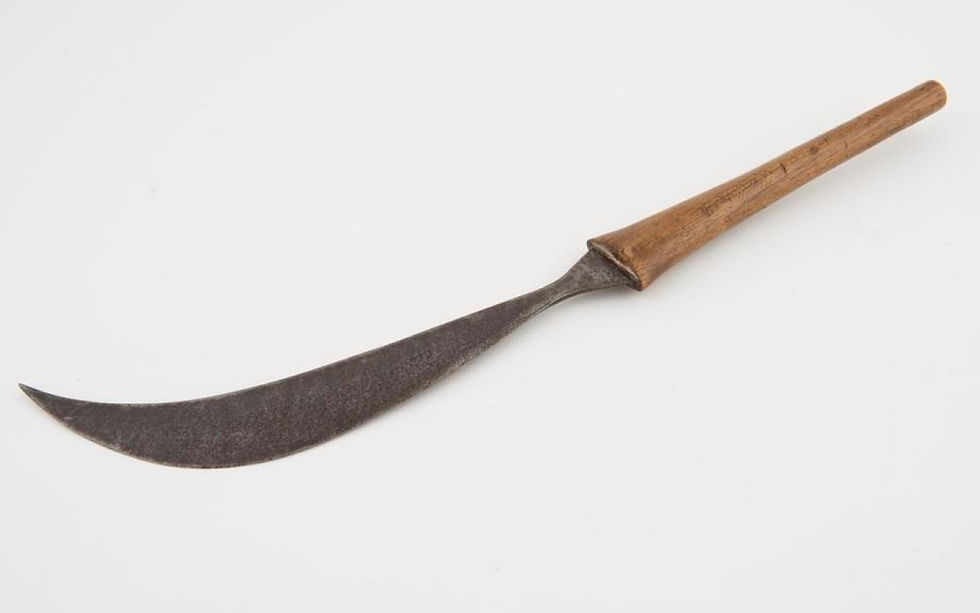
Assistants held the wound edges apart as the infant was delivered, the cord cut, and the placenta removed. The uterus was massaged to promote contraction, and the cervix was dilated internally. No sutures were placed in the uterus.
The abdominal wound was closed using seven polished iron pins fastened with bark cloth string. A paste prepared from chewed roots was applied as a dressing, covered with a warmed banana leaf and a firm bandage. The patient was turned to allow drainage of abdominal fluid. Felkin observed her for eleven days: pins were removed progressively, fresh paste was applied, and by the eleventh day the wound had healed completely with no signs of serious infection. Both mother and child survived and recovered well.
This was not an isolated or experimental procedure. Felkin and later historians noted that the C-section in 1879 reflected a well-established surgical tradition in Bunyoro-Kitara, a powerful centralised kingdom with a high level of medical knowledge developed largely in isolation. Healers demonstrated understanding of antisepsis (via banana wine), anaesthesia, haemostasis through cautery, anatomy, and postoperative wound care using herbal preparations.
Bunyoro surgeons also performed other complex operations, including trephining for head injuries, treatment of penetrating chest and abdominal wounds, and protective inoculations against endemic diseases. This level of expertise challenged 19th-century European stereotypes and suggested generations of empirical refinement.
Similar reports of successful indigenous Caesarean practices emerged from neighbouring regions such as Rwanda, where botanical preparations were used for anaesthesia and healing.
European Contrast and Initial Scepticism
Caesarean sections in Europe carried extreme risks. Maternal mortality remained very high due to infection and haemorrhage. Antisepsis methods promoted by Joseph Lister were still controversial and not universally adopted. The first widely recognised successful European Caesarean, saving both mother and child (involving hysterectomy), occurred in 1876 in Italy, with broader improvements coming later.
Felkin’s detailed report initially faced scepticism in Europe—“almost too good to be true”—but his credibility as an observer helped validate the account. Historians such as J.N.P. Davies later placed it within the broader context of Bunyoro’s medical achievements.
Lasting Historical Significance
The Uganda C-section 1879 stands as powerful evidence of indigenous African medical ingenuity.
It demonstrates that surgical innovation was not confined to Europe and that parallel advancements occurred across continents through careful observation and practice.
Banana wine’s antiseptic properties even influenced later global approaches to wound treatment, according to some accounts.
Today, this history is celebrated as an important chapter in medical anthropology and African scientific heritage.
While modern Caesarean techniques benefit from global advances—including antibiotics, refined incisions, and safe anaesthesia—the Bunyoro example reminds us of overlooked contributions to the development of surgery worldwide.
Felkin’s meticulous documentation preserved a vital record of human ingenuity. For further reading, consult his original 1884 paper, Davies’ 1959 analysis in Medical History, and artefacts preserved in institutions such as the Science Museum Group.


Comments