
Why AI Just Replaced Oil as a Strategic Resource on Earth

Updated: May 19

The industrial world was born in a cloud of coal smoke and matured in a pool of crude oil. For over a century, the hierarchy of global power was written in the language of carbon. To hold the keys to the kingdom was to hold the chokepoints of energy—the Suez Canal, the Strait of Malacca, and the volatile Strait of Hormuz.
Super powers fought world wars to secure these geographies because they believed that the side with the most fuel was the side with the brightest future. In that era, oil was the most strategic resource on earth because its absence meant the literal cardiac arrest of a civilization. If you cut the oil, the tanks stopped, the lights went out, and the people starved.
But as the 2020s come to a close, a silent, invisible transition has occurred. While the world's eyes remain fixed on physical blockades and naval skirmishes, the fundamental "blood" of global power has changed. AI Just Replaced Oil as a Strategic Resource. We have moved from a world governed by the physics of the engine to a world governed by the logic of the algorithm.
Artificial Intelligence has not just entered the battlefield; it has reprogrammed the very definition of a weapon. It has surpassed oil in lethality because it is the only force capable of attacking the decision-making "software" of our species. While oil can halt a machine, AI can subvert the mind that commands it.
This shift has exposed what many strategists now call the systemic limits of American power. The United States, built on the legacy of 20th-century industrial dominance and naval supremacy, finds itself in a paradox: it possesses the most powerful military hardware on earth, yet that hardware is increasingly irrelevant against a weapon that moves at the speed of light and operates within the "invisible plumbing" of the global system.
Before analyzing the lethality of these systems, it is essential to understand the physical network tracking every move on the planet. Read [The Invisible Infrastructure: How Satellites, Ocean Sensors, and AI Are Turning Earth into a Real-Time System] for a deep dive into the sensors and satellites powering this real-time reality.
The Three Stages of Strategic Lethality
To understand why AI has claimed the throne of the deadliest weapon, we must examine the hierarchy of force through three distinct lenses: the power of destruction, the power of disruption, and the power of decision.
Nuclear weapons represent the ultimate physical ceiling of violence. They are the deadliest in terms of raw biological annihilation.
However, as a strategic tool, they are effectively "frozen." Because their use implies the total destruction of the system itself, they have transitioned into tools of psychological deterrence rather than active influence.
You cannot use a nuclear weapon to win a trade war, influence a local election, or secure a digital network. They are the "ultimate No" in a world that requires a "constant Yes."
Oil, conversely, is the weapon of the industrial pulse. Its lethality is derived from our extreme systemic dependence. According to the U.S. Energy Information Administration (EIA), nearly 21 million barrels of oil pass through the Strait of Hormuz daily.
A complete cutoff of this flow doesn't just stop cars; it collapses the fertilizers required for food, the cold chains required for medicine, and the stability of global currency. Oil is a weapon of asymmetric leverage, allowing regional actors to hold the global economy hostage.
"Oil was the weapon of the 20th century because it controlled movement. AI is the weapon of the 21st because it controls reality."
AI is the deadliest weapon because it is active, invisible, and autonomous. Unlike a nuclear warhead, it is used every second of every day in the form of cyber-intrusions, algorithmic market manipulation, and cognitive warfare. Unlike oil, it does not require a physical strait to be effective.
AI is the power of decision. It attacks the "operating system" of society. It is the first weapon in history that can achieve the total goals of war—regime change, resource theft, and strategic subversion—without ever firing a kinetic shot or spilling a single drop of fuel.
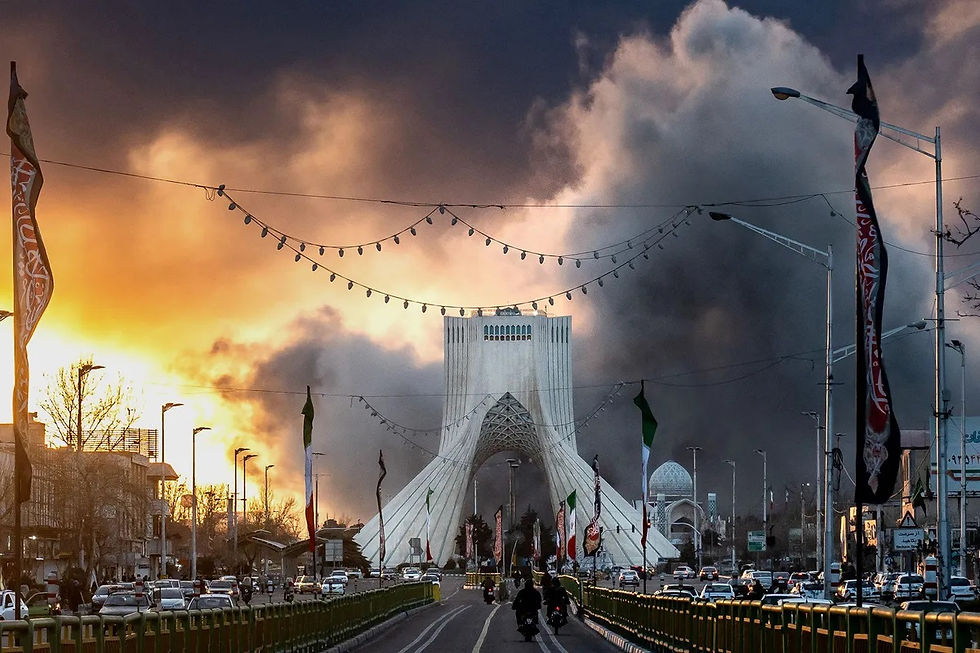
The End of Kinetic Surprise and the New Geography of Power
For millennia, military victory was built on the element of surprise. From the Trojan Horse to the blitzkrieg of 1940, the side that could move in secret held the advantage. However, the rise of AI-driven surveillance has effectively ended the era of kinetic surprise.
We now live in a world of "Shared Visibility." Commercial satellite constellations, processed by advanced AI models, now render every troop movement, every tanker detour, and every carbon signature visible in near real-time.
As reported by Janes Defense Weekly, the recent conflicts in the Middle East and Eastern Europe have demonstrated that the "transparent battlefield" is now a permanent reality. When everyone sees everything, the traditional naval "show of force" loses its psychological edge.
This is a primary example of the systemic limits of American power. A carrier strike group is a massive, visible target in a world where AI-guided hypersonic missiles can be triggered by satellite data processed in milliseconds.
The advantage no longer goes to the side with the most physical "steel," but to the side with the best algorithm for interpreting the data.
If an adversary's AI can process 50,000 video streams and satellite pings to predict a fleet’s destination ten minutes before the human commander makes the decision, the physical power of that fleet is neutralized before it even arrives. In this new geography, the "high ground" is no longer a hill or a sea lane; it is a data center.
AI Just Replaced Oil as a Strategic Resource: The Limits of American Power in Algorithmic Warfare
The United States military is designed for a world of "Command and Control." This doctrine assumes a clear hierarchy, a clear enemy, and a clear battlefield. However, AI operates in the "grey zone"—the space between peace and war where influence is negotiated through systemic shocks.
The systemic limits of American power are most visible in the inability of traditional military force to deter algorithmic subversion. When an AI-driven disinformation campaign slowly erodes the social cohesion of a domestic population, an aircraft carrier is useless. When an autonomous trading algorithm triggers a "flash crash" in a rival's stock market, a stealth bomber cannot retaliate.
"The paradox of modern supremacy is that the more integrated a superpower is into the global system, the more vulnerable it becomes to the systemic weapons of its rivals."
The World Economic Forum (WEF) has highlighted that geoeconomic confrontation and AI-driven misinformation are now the highest-priority risks to global stability. The U.S. finds itself in a position where its very strengths—its financial leadership and its open internet—are the primary vectors through which AI weapons attack. This is a structural vulnerability that no increase in the defense budget can fully solve. It requires a shift from "force projection" to "systemic resilience."
The Weaponization of Interdependence
In the industrial age, you destroyed an enemy's capacity for war by bombing their factories and cutting off their oil. In the algorithmic age, you achieve the same result by weaponizing the very systems they rely on for survival. This is the "Weaponization of Interdependence."
Consider the global financial clearing system. For decades, the U.S. has used its control of the dollar as a tool of power. But the rise of AI-driven "fintech" and alternative digital ledgers is creating firewalls that bypass this control.
BRICS+ nations are currently developing AI-managed "multi-currency" pools that can rebalance trade in real-time without ever touching a Western bank. This reduces the efficacy of sanctions, one of the most potent non-kinetic weapons in the American arsenal.
Furthermore, AI can weaponize a nation's own "just-in-time" supply chains. By subtly manipulating the data flows that govern logistics, an adversary's AI could cause a national food shortage or a medical supply crisis without ever attacking a physical ship.
This is "Death by a Thousand Glitches." It is deadlier than an oil blockade because it is harder to identify, harder to attribute, and almost impossible to stop once the cascade begins.
Regional Comparisons and the Race for Compute Sovereignty
The shift from oil to AI as the deadliest weapon is causing a massive realignment in regional strategies. The race for "Compute Sovereignty" has replaced the race for oil fields.
The East Asian Nexus:
China, India, and Japan have recognized that their energy dependence (their "oil vulnerability") can only be offset by an AI advantage. China's "Intelligentization" of its military is an explicit attempt to find the weaknesses of American power and exploit them. They are not trying to build more carriers than the U.S.; they are trying to build an AI that makes carriers irrelevant.
The Gulf Pivot:
The traditional oil powers—Saudi Arabia and the UAE—are perhaps the most aware of this transition. They are currently pivoting their sovereign wealth at a staggering rate, moving from "drilling for oil" to "harvesting data." As noted by the New Development Bank (NDB), the Gulf is positioning itself to be the world's "data refinery," using their cheap energy to power the massive server farms required for the next generation of Agentic AI.
The European Dilemma:
Europe remains a "regulatory superpower" but a "computational colony." While the EU has reduced its dependency on Russian oil, it has replaced it with a dependency on American and Chinese AI software. This creates a different kind of systemic limit, where European sovereignty is bounded by the algorithms of foreign corporations.
The Invisible Battlefield of Cognitive Warfare
Perhaps the most insidious reason AI has replaced oil is its ability to attack the "Cognitive Infrastructure" of a nation. Oil could starve a body, but AI can reprogram a mind.
Cognitive warfare is the use of AI to manipulate the perception of reality for a target population. By controlling the information feed, an adversary can influence elections, trigger civil unrest, and destroy the "internal trust" that allows a democracy to function. This is the ultimate systemic weapon. If you can convince a population that their leaders are illegitimate or that their neighbors are enemies, you have won the war without a single soldier crossing a border.
The International Energy Agency (IEA) has long analyzed how oil shocks cause social unrest. But an AI-driven "truth shock" is far more dangerous. In a world of deepfakes and algorithmic echo chambers, the ability to maintain a "shared reality" is the new national security. The U.S drawbacks are painfully clear here: the very First Amendment values that define the U.S. also make it the most "open" target for cognitive warfare.
The Agentic Revolution and the End of Human Decision Speed
The most terrifying development in 2026 is the move toward Agentic AI—systems that do not just follow instructions but plan and execute entire strategic workflows. These are the "Slaughterbots" of the digital age, but their lethality isn't just physical.
An Agentic AI weapon can:
Identify a vulnerability in a rival's energy grid.
Infiltrate the network through an automated cyber-attack.
Simultaneously execute a short-sell of the rival's currency.
Launch a disinformation campaign to blame a third party for the blackout.
All of this happens at a speed that exceeds human cognition. When the weapon thinks faster than the target can realize it is under attack, the concept of "defense" becomes a relic. The systemic limits of American power are reached when the OODA loop (Observe-Orient-Decide-Act) of the Pentagon is slower than the processing speed of an adversary's AI "Agent."
"In the age of AI, the speed of your hardware is secondary to the latency of your logic."
From Command and Control to Navigate and Adapt
In this world where AI is the deadliest weapon, the old metrics of power—GDP, number of tanks, barrels of oil—are insufficient. We are entering the era of "Systemic Resilience."
As the World Economic Forum argues, the only way to survive a systemic world order is to build "redundancy" and "flexibility." For the United States, this means realizing that the systemic limits of American power are not a sign of decline, but a call for transformation. The U.S. must move away from "Command and Control" and toward "Navigate and Adapt."
This involves:
Decentralization: Moving away from a few massive "critical nodes" (like large-scale power grids or centralized data hubs) and toward a mesh-network of local resilience.
Algorithmic Accountability: Building AI that is "defensive" by design, capable of identifying and neutralizing foreign cognitive attacks.
Economic Redundancy: Reducing the "Just-in-Time" fragility of supply chains so that a single AI-driven glitch doesn't lead to a national crisis.
The Hierarchy of Lethality and the Future of Influence
To summarize the shift, we can look at the "Lethality Matrix." While a nuclear weapon is the deadliest to life, and oil is the deadliest to movement, AI is the deadliest to order.
Weapon Type | Target | Effect | Strategic State |
Nuclear | Biological | Annihilation | Frozen (Deterrence) |
Oil | Physical | Paralysis | Declining (Transition) |
AI | Systemic | Subversion | Active (Dominance) |
The future of influence belongs not to the nation that can "win" a war for a sea lane, but to the nation that can maintain its internal coherence in the face of algorithmic chaos. The 40-Day War at the Strait of Hormuz was the last great conflict of the Oil Era. It showed that while we are still physically tethered to carbon, our strategic reality is now digital.

The Post-Hormuz Reality
The limits of American power revealed in the Hormuz crisis point toward a broader truth: power is no longer about dominance alone; it is about positioning within the system. The U.S. remains the world's leading power, but it is no longer the world's only "operator."
As we move toward 2030, the "Deadliest Weapon" will continue to evolve. AI will become more autonomous, more invisible, and more integrated into our very biological existence. The nations that thrive will be those that understand the system well enough to operate within its limits—and still shape outcomes.
The era of oil-based hegemony is closing. The era of algorithmic sovereignty has begun.
The transition from oil to AI as the primary weapon of global power is not a temporary shift; it is a fundamental "phase change" in human history. For the last 150 years, the goal of every great power was to secure the physical world (territory and resources). For the next 150 years, the goal will be to secure the "Synthesized World" (data and intelligence).
What this means for tomorrow:
The Death of Neutrality: In an AI-governed system, there is no "neutral" ground. Every digital connection is a vector for influence. Small nations will no longer be able to "sit out" global conflicts; they will be forced to choose which AI "ecosystem" (Western or Eastern) they will inhabit.
The Rise of the "Sovereign AI": Governments will stop buying weapons and start building "Sovereign Intelligence" systems—AI models trained exclusively on national data and protected by physical "air-gaps." This will lead to a "Splinternet" where different regions operate under entirely different digital realities.
The Redefinition of Human Rights: As cognitive warfare becomes the standard tool of statecraft, the "Right to a Private Mind" will become the most important human rights battle of the century. Protecting citizens from algorithmic manipulation will be as vital as protecting them from physical violence.
The future belongs not to the side with the most "firepower," but to the side with the most "processing power." We are no longer fighting for the earth under our feet; we are fighting for the reality inside our heads.



Comments