
Weaponising the Strait of Hormuz as the Iran War Continues


For much of the past week, there was cautious optimism that one of the world's most strategically important waterways had stepped back from the brink. The reopening of the Strait under the US-Iran Memorandum was widely interpreted as the first tangible success of the agreement. Commercial shipping gradually resumed, oil exports increased towards pre-war levels, insurance premiums began to ease, and energy markets responded by lowering oil prices that had risen sharply during the conflict.
Those gains now appear increasingly fragile. Weaponising the Strait of Hormuz has once again become the primary tactic of choice, shifting international attention back towards the narrow stretch of water connecting the Persian Gulf with the Gulf of Oman.
"The hard part is done, so it should be easy. Go to the strait and just take it. Protect the oil you so desperately depend on, or buy it from the United States. We have so much."— Donald Trump, addressing nations reliant on the shipping lane
Although measuring barely 33 kilometres at its narrowest point, the Strait remains one of the most important maritime chokepoints on earth.
Before the conflict, global markets relied on a massive volume of energy flowing through this bottleneck, averaging roughly 20 to 21 million barrels per day (bpd) of crude oil and petroleum products—nearly a fifth of the world's daily petroleum consumption.
Today, even short disruptions can ripple through global supply chains. According to the US Energy Information Administration, ongoing regional tensions have forced major oil production to shut down. At their peak, these disruptions affected about 11.3 million barrels of oil per day, as transport routes became congested and storage facilities reached their limits.
That reality explains why military incidents in the Strait rarely remain regional problems.
Every attack on a commercial vessel, every reported mine, every intercepted drone and every deployment of naval assets immediately becomes a global economic issue. Commodity traders respond by adjusting risk premiums. Shipping companies reassess transit routes. Insurance firms recalculate exposure. Governments begin evaluating the resilience of their strategic petroleum reserves.
In other words, uncertainty itself becomes a strategic weapon. This broader dynamic has featured prominently throughout FTN's coverage of the conflict.
In Strait of Hormuz Oil Flow Nears Pre-War Levels, FTN argues that while tanker movements had recovered following the signing of the memorandum, confidence had not fully returned. Shipping companies welcomed the reopening of the corridor, yet many continued to exercise caution, recognising that political agreements alone cannot eliminate operational risk in one of the world's most militarised waterways.
The latest developments appear to validate those concerns. Reports of attacks on commercial shipping, followed by retaliatory military action and renewed aerial activity across the Gulf, demonstrate how quickly confidence can vaporise.
Even when tankers continue moving through the Strait of Hormuz, the waterway can still be used as a strategic pressure point. By creating calculated maritime friction rather than imposing a complete blockade, Iran can raise the cost of global trade almost immediately. Higher insurance premiums, rising freight rates, stricter security inspections and greater uncertainty across energy markets all add to the economic burden without a single ship being stopped.
That strategy is reflected in the Islamic Revolutionary Guard Corps (IRGC) Navy's public position:
"Any new transit route established without coordination with Tehran is unacceptable and dangerous. Only the shipping routes designated by Iran are permitted for passage."
The statement underscores Iran's determination to assert influence over one of the world's most strategically important maritime chokepoints, signalling that control over navigation can be exercised through regulation and deterrence as much as through military force.
That uncertainty extends beyond oil. The Strait of Hormuz has become a symbol of a much larger geopolitical contest unfolding across the Middle East.
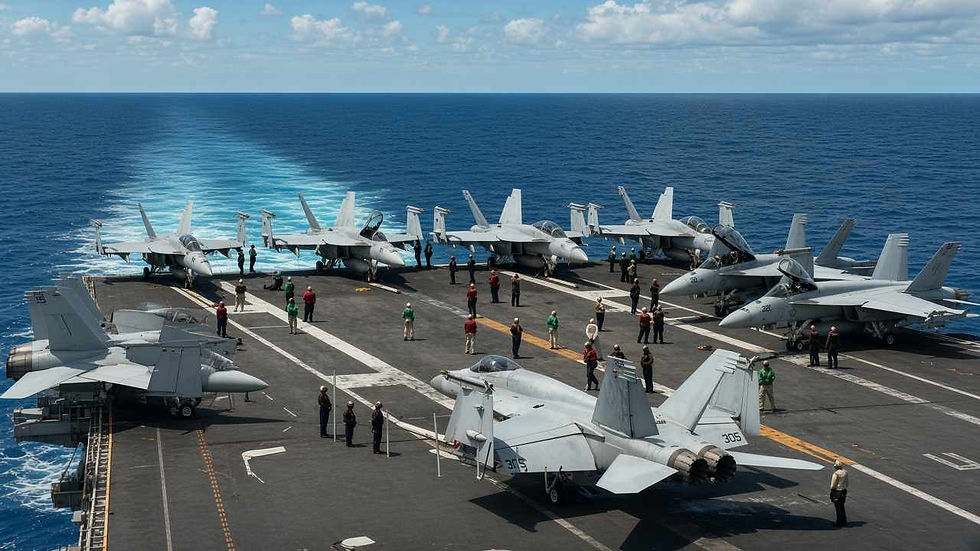
For decades, successive American administrations regarded freedom of navigation through the Gulf as a strategic imperative supported by an extensive military presence stretching from Bahrain and Qatar to Kuwait and the United Arab Emirates. Iran, meanwhile, has consistently viewed foreign military deployments close to its coastline as an enduring security threat while asserting its own influence over the surrounding waters.
The US-Iran Memorandum sought to reduce those competing pressures by creating a phased process through which military tensions could gradually diminish alongside diplomatic negotiations. Instead, recent events suggest that both sides continue to rely upon military signalling even while publicly committing themselves to diplomacy.
That contradiction reflects a broader transformation taking place across international relations. Military confrontation is no longer confined to conventional battlefields. States increasingly compete by applying pressure to the infrastructure that underpins global commerce.

Energy corridors, shipping lanes, digital networks, financial systems and critical supply chains have become instruments of geopolitical influence alongside traditional military power.
FTN examined this changing landscape in The Invisible Blockade: How Superpowers Rule Through Friction, arguing that modern competition is increasingly defined not by territorial conquest but by the ability to introduce uncertainty into the systems upon which economies depend.
Rather than occupying countries directly, major powers now influence global affairs by creating friction within trade routes, financial markets and strategic infrastructure. The resulting instability shapes investment decisions, commodity prices and diplomatic decision-making far beyond the immediate theatre of conflict.
The Strait of Hormuz exemplifies that reality.
Its importance lies not simply in geography but in its systemic role within the global economy. Every escalation within the Strait reverberates through financial markets in London, manufacturing centres in East Asia, refineries across Europe and consumer economies around the world.
Decisions taken by military commanders in the Gulf can influence inflation, transport costs and economic growth thousands of kilometres away.
This is precisely why governments continue monitoring developments so closely. The current crisis is no longer solely about whether the US-Iran Memorandum survives its first major test. It is about whether one of the world's most interconnected economic systems can continue functioning when the political and security architecture that supports it is proving inadequate for an increasingly multipolar world.


Comments