
Trump and Netanyahu Vow Iran Regime Change as Rusting USS Abraham Lincoln Docks in Thailand


The war in Iran is entering another revealing phase, and the rhetoric coming from Washington and Jerusalem is becoming increasingly explicit.
Yesterday, Donald Trump again called on Iranians to rise against their government.
Today, Israeli Prime Minister Benjamin Netanyahu has openly declared that the objective is to bring down the Iranian regime.
“The regime in Iran will fall. We will bring it down. It is already on its last legs,” Netanyahu said, adding that “all our systems” under his leadership were acting to overthrow the regime.
The declaration comes as the United States and Iran have returned to intense military confrontation around the Strait of Hormuz.
American forces have struck approximately 100 targets in Iran, including air-defence systems, radar installations, maritime assets, mine-laying capabilities, and communications infrastructure.
Iran has responded with missile and drone attacks against American positions and allied territory across the region, including Bahrain, Jordan, Kuwait, and Iraq.
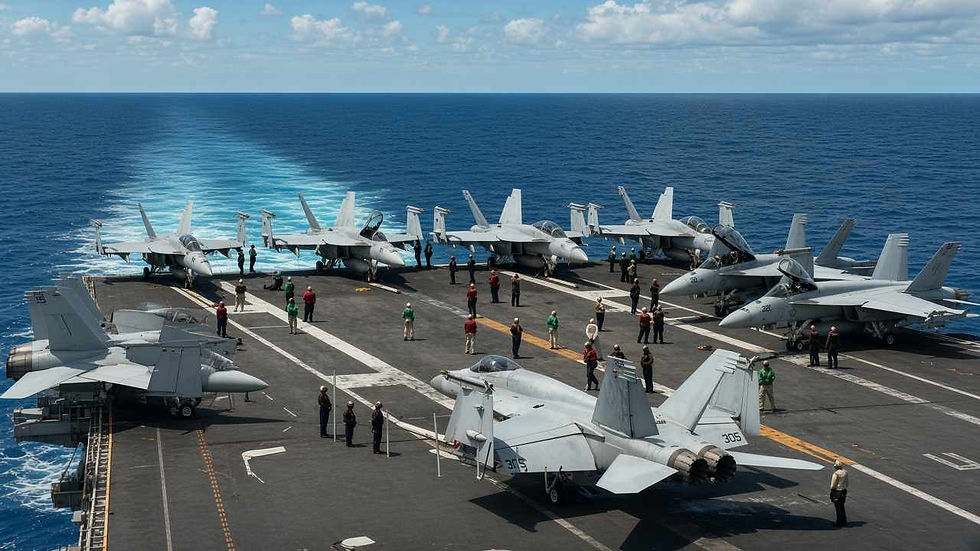
Yet as the political leadership of the United States and Israel speaks confidently about forcing political change in Tehran, an extraordinary image has emerged from the other side of the military equation: a rusting USS Abraham Lincoln docked at the Laem Chabang port in Thailand after one of the longest and most demanding deployments of a modern American aircraft carrier.
The USS Abraham Lincoln Docks in Thailand
On Wednesday, September 2, the nuclear-powered USS Abraham Lincoln steamed into Laem Chabang Port in Chonburi province, eastern Thailand, after 286 days at sea.
Approximately 5,000 sailors and Marines were aboard the carrier and its strike group.
The arrival was significant not simply because the carrier had reached Thailand, but because of what the ship and its crew represented after almost ten months of sustained deployment.
Lincoln had been deployed since November and spent more than 260 consecutive days at sea, supporting American military operations in the Middle East as the Iran war unfolded.
During the deployment, the carrier participated in combat operations and the U.S. naval blockade around Iran, with American officials saying its aircraft conducted more than 10,000 sorties.
Thailand therefore represents something much more than another stop on a naval itinerary.
For thousands of sailors and Marines, it is a badly needed period of rest after an extraordinary period of operational pressure.
The ship is scheduled to spend several days in the area while its crew gets time ashore before the long journey home.
But it was the physical appearance of the carrier that immediately captured attention.
The enormous hull arrived with extensive rust streaks and heavily weathered paint along the waterline, while aircraft and other equipment on the flight deck showed the unmistakable effects of prolonged exposure to the sun and salt water.
For a warship designed to project American military power around the world, this image is striking.

Trump and Netanyahu’s Iran Regime Change Strategy
The push for Iran regime change has now become an increasingly explicit part of the war’s political narrative.
President Donald Trump has continued to apply pressure on Tehran while calling on Iranians to rise against their government.
At the same time, Israeli Prime Minister Benjamin Netanyahu has openly declared that the Iranian regime is already on its last legs and that Israel is acting under his leadership to bring it down.
Their statements mark a significant shift from military pressure aimed primarily at degrading Iran’s capabilities toward a strategy that openly contemplates changing the political leadership of the country.
The problem for Washington and Jerusalem is that destroying military infrastructure is considerably easier than removing a political system that has survived decades of sanctions, internal pressure and external confrontation.
The latest American strikes have hit Iranian air-defence systems, radar installations, maritime assets and communications infrastructure, while Iran has continued retaliating against American and allied positions across the region.
The exchange demonstrates the enormous military pressure being placed on Tehran, but it also shows why Iran regime change may prove far more difficult than its advocates suggest.
That difficulty is central to understanding the wider conflict.
As FTN previously examined in Iran War: The Long Game for Middle East Dominance, the war has increasingly become an endurance contest in which economic pressure, maritime disruption and military capacity are being tested over time.
Iran's ability to continue operating under pressure therefore matters just as much as the number of targets destroyed by American and Israeli forces.
The condition of the USS Abraham Lincoln adds another dimension to that calculation.
After an extraordinary deployment lasting hundreds of days, the carrier has finally reached Thailand to rest and recover. Its weathered and rust-streaked appearance has become a powerful visual representation of the physical demands of sustaining American military power through a prolonged conflict.
FTN explored that question in USS Abraham Lincoln: What the Iran War Reveals About U.S. Power, examining what the carrier's unprecedented deployment reveals about the costs and limits of American power.
The central question now is whether military pressure can produce the political outcome Trump and Netanyahu appear to want.
Iran regime change would require not simply weakening Iran's armed forces but disrupting the political structures that have allowed its leadership to absorb punishment and continue fighting.
That makes the next phase of the war potentially even more consequential, because the contest is no longer only about who can destroy more targets. It is about who can endure long enough to shape what comes after the fighting.
The Lincoln Shows the Price of Sustaining American Power
The condition of the USS Abraham Lincoln does not mean that American naval power has collapsed. It does, however, provide a rare physical illustration of what prolonged warfare does to even the world's most sophisticated military machinery.
The carrier is a floating military city, carrying thousands of people and operating aircraft, radar, communications systems, weapons and propulsion machinery in one of the harshest environments imaginable.
Every additional day at sea imposes a cost.
Every aircraft sortie requires maintenance. Every weapon fired must eventually be replaced.
Every sailor who remains deployed must continue working, eating, sleeping and performing duties under conditions far removed from ordinary life.
The longer the deployment continues, the greater the burden becomes.
The Lincoln was intended to be an unmistakable symbol of American reach. After months of continuous operations, it has become something else as well: a physical measure of the demands required to maintain that reach.
The rust itself is not the story.
The time required to accumulate it is.
Nearly 5,000 Sailors Are Coming Off a Historic Deployment
The human dimension may be even more important than the condition of the ship.
Approximately 5,000 sailors and Marines have spent months living within the confines of the carrier strike group.
Their families have endured long periods of limited contact, uncertainty and concern as the Lincoln moved from one operational theatre to another.
Reuters reported that some families described low morale, limited communication and genuine fear for their relatives during the deployment.
The prolonged deployment has also generated reports and political concern over food supplies, hygiene, mental health and other living conditions aboard the ship.
Some of the most serious allegations have been disputed or downplayed by Navy officials, but the fact that the welfare of the crew has become a political issue demonstrates how unusual the deployment has been.
The Navy itself describes the Thailand stop as an opportunity for sailors and Marines to “rest and recharge,” while senior officers have praised the crew's professionalism and resilience.
That language is revealing in itself.
A force that has just completed a normal deployment does not normally become a global symbol of endurance.
Hormuz Has Turned the War Into a Test of Endurance
The reason the carrier remained deployed for so long is closely connected to the strategic importance of the Strait of Hormuz.
The waterway has become one of the central pressure points of the war.
Washington wants to keep commercial shipping moving and prevent Iran from using mines, missiles and maritime forces to control the passage.
Tehran, meanwhile, has demonstrated that its ability to threaten shipping gives it leverage far beyond its conventional military strength.
The latest American strikes targeted Iranian capabilities associated with air defence, radar, maritime operations and mine-laying.
Iran's retaliation then expanded the geographic reach of the conflict, with attacks directed toward American forces and installations across several Middle Eastern countries.
This is no longer simply a war between two countries.
It is a regional military contest in which bases, shipping routes, energy infrastructure and allied governments have all become part of the strategic equation.
And the longer that continues, the more important endurance becomes.
The Long Game for Middle East Dominance
This is precisely where FTN's second analysis, The Invisible Blockade: How Superpowers Rule Through Friction, becomes relevant.
The war is increasingly defined not only by who can destroy more targets but also by who can sustain pressure for longer without suffering unacceptable economic, political or military consequences.
Iran is under enormous pressure. Its currency has weakened dramatically, its military infrastructure has suffered repeated attacks, and its ability to move oil through the Gulf has been severely disrupted.
The United States, as a superpower, is drawing resources from across the globe to maintain this friction campaign.
The deployment of a carrier strike group for hundreds of days requires enormous logistical resources.
Ships require maintenance.
Aircraft require replacement parts.
Personnel require relief.
Ammunition stocks must be replenished.
And most importantly, the political leadership must explain to its population why the war is continuing and what victory is supposed to look like.
The Lincoln arriving in Thailand after 286 days is therefore not simply a naval story.
It is part of a larger strategy of the war.
Can Military Pressure Actually Produce Regime Change?
The central question now confronting Washington and Jerusalem is whether military pressure can be converted into political collapse.
That remains far from certain.
Iran's government has demonstrated a capacity to absorb military punishment while continuing to retaliate. Its ability to threaten the Strait of Hormuz gives Tehran an instrument through which it can impose costs on the global economy, while its missile and drone attacks allow it to extend the battlefield beyond Iran's borders.
At the same time, the United States possesses overwhelming advantages in air power, naval power, intelligence, logistics and long-range strike capability.
The result is a dangerous strategic paradox.
The United States can continue hitting Iran.
Iran can continue imposing costs on the United States and its allies.
Israel can continue seeking the destruction of Iranian military and political capabilities.
And yet none of those capabilities automatically answers the fundamental political question: what comes after the Iranian regime?
That is the part of regime change that bombs cannot solve.
The Rust on the Lincoln Is a Warning About the War
The USS Abraham Lincoln remains a formidable warship.
Its arrival in Thailand in a deplorable state does not erase American military superiority, nor does the rust covering parts of its exterior mean that the carrier has ceased to function as a combat machine.
But the photographs tell a story that official military statements rarely communicate.
They show the physical consequences of time and a resilient Iran.
They show what happens when a machine designed for deployment is kept at sea for almost ten months while supporting an active war.
And behind the rusted and broken-down toilet facilities are thousands of people who have endured stress, strain and suicides through the same passage of time.
That makes Lincoln a strong litmus test of the ensuing conflict.

Trump and Netanyahu are talking about the collapse of Iran's regime.
Iran is fighting to prevent that outcome.
The Strait of Hormuz remains closed and a critical battleground.
The United States continues to deploy enormous military resources to sustain its campaign.
The Iranian regime, meanwhile, remains standing.
But after 286 days at sea, the USS Abraham Lincoln has finally reached a place where its crew can step ashore, rest and begin preparing to head home to their families
And that may be the most important fact of all.
About the Author

Tinka C. Muhwezi is the Editor-in-Chief and Producer at Frontier Tech Network (FTN), a media and technology platform covering world news, science, technology, innovation and emerging trends.
With over 25 years of experience in science journalism, broadcasting, storytelling, video production and digital media strategy, he brings a multidisciplinary perspective to global developments.
Tinka C. Muhwezi has also taught mass communication, multimedia video and photography at universities and has worked across journalism, media production, digital communications and technology.
Through FTN, he combines journalism, research and visual storytelling to examine major geopolitical, technological and social developments shaping the modern world.

Comments