
US War on Iran: Trump Expands Military Pressure as Three Carriers Move Towards Iran

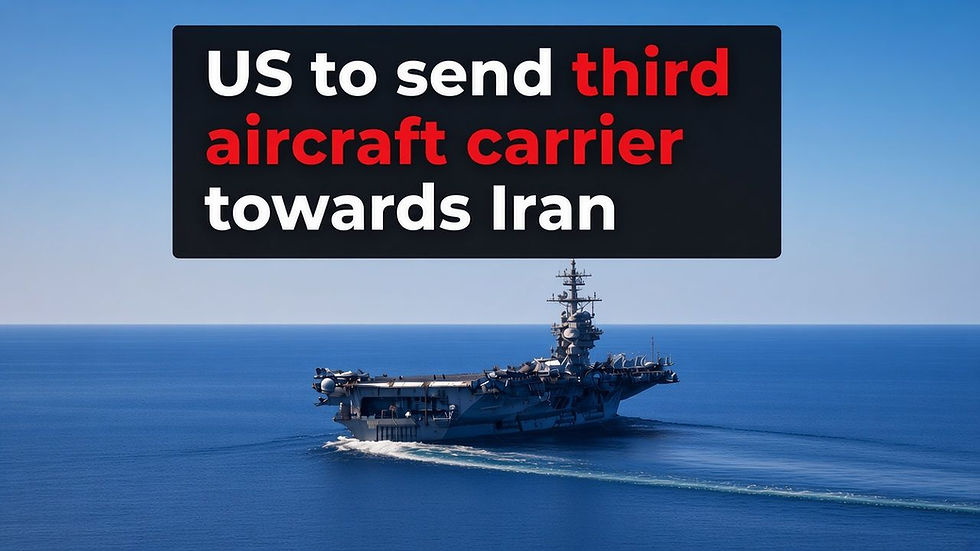
The US war on Iran has entered another phase, and the latest American military deployment suggests that Washington is preparing for a confrontation that is proving much harder to close than the original campaign implied.
A US official has told Al Jazeera that the USS Theodore Roosevelt carrier strike group has left San Diego for the Middle East, followed by the Makin Island Marine Expeditionary Force carrying more than 2,000 Marines.
If the deployment proceeds as described, three US aircraft carriers and two amphibious landing groups could be positioned around Iran by the end of November, alongside roughly 50,000 American service members already in the region.
At almost the same time, President Donald Trump is insisting that the confrontation could end “very soon," while maintaining that Iran must reach an agreement with Washington. The United States has therefore arrived at a familiar but increasingly consequential position: diplomacy is being discussed, but the military option is growing rather than shrinking.
That contradiction is important because the Iran conflict is no longer simply a question of whether American forces can inflict more damage on Iran.
The harder question is what happens after that damage has been inflicted.
Can Washington convert military superiority into a political settlement?
Can Iran be pressured into surrendering the strategic leverage it has accumulated around the Strait of Hormuz?
Can the United States sustain the cost of a prolonged deployment while American voters become more sceptical of the war?
US War on Iran: Three Carriers Signal a Longer Strategic Contest
The deployment of the Theodore Roosevelt and Makin Island groups is significant because it gives Washington additional military options while negotiations remain uncertain.
Al Jazeera reports that the Pentagon does not intend to withdraw its assets even if an agreement is reached, while Defence Secretary Pete Hegseth has said US forces remain ready should Trump order further strikes.
That is not necessarily evidence that another major attack has already been decided. It does, however, demonstrate the logic governing Washington's position. The United States wants diplomacy to succeed without giving up the military leverage that it believes makes diplomacy possible.
Iran is approaching the same problem from the opposite direction.
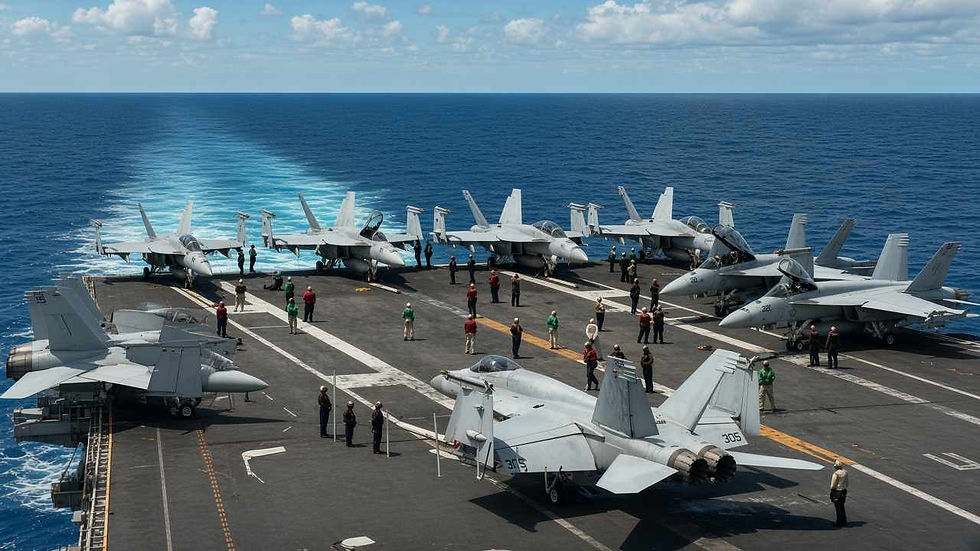
Tehran has spent months demonstrating that it does not need to match the United States ship for ship or aircraft for aircraft. Its strategy has been to preserve enough military, economic and geographic leverage to prevent Washington from dictating the terms of the conflict.
That distinction was at the centre of FTN's earlier analysis, U.S. Iran War Losses: Did America Lose the Strategic War?
The evidence shows that Iran did not defeat the United States in battle. The US military is still far more powerful. Even so, both sides have badly damaged each other's important infrastructure.

That is where the latest deployment becomes more interesting.
If the United States is still adding carriers and amphibious forces months into the confrontation, the central contest is no longer simply about the ability to strike Iran.
It is about how long each side can maintain pressure before the political, economic and military costs become more difficult to sustain.
Hormuz Has Become the Real Measure of Leverage
The Strait of Hormuz sits at the centre of this conflict.
Iran has repeatedly treated the waterway as strategic leverage rather than simply a shipping route.
Washington wants predictable access through the Strait because uncertainty around it affects energy prices, shipping, insurance and global trade.
Tehran, meanwhile, has little incentive to surrender one of its strongest bargaining instruments without receiving something substantial in return.
That is why the latest US military buildup cannot be separated from the diplomatic negotiations.
FTN's Strait of Hormuz Deal: Iran Raises the Stakes examined precisely this problem. Tehran's conditions for reopening the waterway include sanctions relief, compensation, an end to military threats, removal of the naval blockade and access to frozen Iranian assets.
Reports that Trump may be prepared to prioritise reopening Hormuz while leaving the nuclear question for later negotiations point towards a narrower objective: stabilising the world's most important energy corridor first and postponing the harder political dispute.
The logic is straightforward.
Washington wants the Strait open because prolonged disruption carries consequences far beyond Iran. Tehran wants concessions before giving up the leverage that makes Washington care so urgently about reopening it.
The two sides therefore remain locked in a negotiation in which neither possesses complete control.
America has the military power to impose enormous costs on Iran.
Iran has the geographic leverage to impose costs on the wider global network in which America operates.
That is why Hormuz has become more than a regional waterway. It has become a measure of strategic bargaining power.

The War Did Not End When the Shooting Slowed
This is why the conflict cannot be understood simply as a war that began with military action and ended with a ceasefire. The fighting may have slowed, but the ripple it has produced has continued through energy markets, maritime security, sanctions, intelligence, financial networks and regional alliances.
FTN's Iran War: The Long Game for Middle East Dominance explores this shift, arguing that the forty-day confrontation did not resolve the underlying struggle for influence.
Instead, it moved into a longer contest in which the United States is reinforcing its military presence, Iran is seeking to preserve its leverage, and the Strait of Hormuz remains central to negotiations.
At the same time, sanctions remain a central part of Washington’s pressure campaign, while Russia is positioning itself as both a diplomatic intermediary and a source of strategic support for Tehran. China, meanwhile, remains deeply tied to the energy networks whose stability is being disrupted by the confrontation.
The conflict is therefore no longer centred on the prospect of one decisive military outcome. Its next phase will be shaped by which side can sustain pressure while preserving enough leverage to negotiate an agreement on terms it can accept.
The deeper contest is no longer simply about who can strike harder. It is about who can endure longer without surrendering the leverage needed to influence what comes next.
America's Military Advantage Is Being Questioned
The experience of the USS Abraham Lincoln illustrates the problem.
FTN previously examined the carrier's extraordinary deployment in U.S. Iran War Losses: Did America Lose the Strategic War? The carrier spent more than 250 days at sea, with roughly 200 days without a port call, while lawmakers raised concerns about shortages, water problems, mail disruption, crew exhaustion and mental-health conditions.
The Pentagon disputed parts of the reporting, but the sheer length of the deployment exposed the growing strain on US forces at sea.
Sustaining a major warship for so long requires enormous logistical and human resources, particularly in a conflict against an unpredictable adversary like Iran, whose ability to retaliate and keep Washington under pressure has made the war increasingly difficult to contain.
That is especially relevant now that Washington is preparing to add another carrier rather than simply rotate forces and reduce its footprint.
The question becomes whether the United States can maintain this level of military pressure indefinitely while also managing the economic and political consequences of the war.
Military power matters.
But the ability to sustain military power matters too.


Comments