
Princess Ruth Komuntale Disputes Tooro New King Announcement

Updated: Sep 12

Tooro’s Royal Succession Takes Another Unexpected Turn
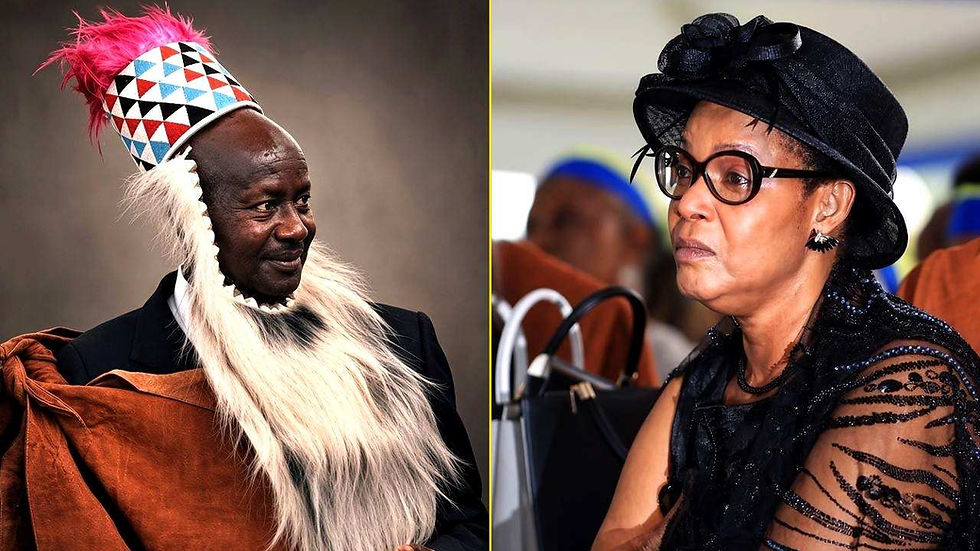
The announcement of Tooro’s new king has been thrown into fresh uncertainty after Princess Ruth Komuntale said the information released about the succession was inaccurate.
The intervention by one of the kingdom’s prominent royals comes as Tooro is still grappling with the death of Omukama Oyo Nyimba Kabamba Iguru Rukidi IV and a succession process that has already produced conflicting claims over who should inherit the throne.
The question now is no longer simply who is Tooro’s new king? It is whether a new king has been formally and conclusively identified at all.
Another Twist in the Tooro Succession Story
Edward Rukidi Kijanangoma had emerged as the latest name presented as a successor to the late King Oyo.
A member of the Tooro royal family, Kijanangoma is also known to Ugandans through his work as a news anchor and editor at Uganda Broadcasting Corporation.
FTN examined his background and his emergence in Tooro’s New King: Who Is Edward Rukidi Kijanangoma?, which traced the royal and professional journey of the man now at the centre of the latest succession development.
But his reported selection followed an earlier announcement involving George Desmond Kamurasi.
Kamurasi had previously been reported as the royal family's selected successor to King Oyo, immediately putting his name at the centre of a succession debate involving royal lineage, family connections and the authority of those involved in choosing the next Omukama.
FTN reported that development in Tooro Kingdom Succession: George Desmond Kamurasi Selected as New King.
That announcement was itself followed by another challenge.
Omusuuga Charles Akiiki Kamurasi distanced himself from claims by Andrew Mwenda that George Desmond Kamurasi had been selected as King Oyo’s successor, further exposing divisions and uncertainty surrounding the process.
FTN examined that dispute in Tooro Kingdom Succession Crisis: Omusuuga Challenges Mwenda’s Claim.
The dispute began after journalist Andrew Mwenda reported on September 4 that the 21-member Tooro Royal Succession Committee had selected George Desmond Kamurasi as the preferred successor to King Oyo. Mwenda said 18 committee members attended a meeting at Fort Motel in Fort Portal, with 15 voting in favour of Kamurasi.
That report immediately appeared to settle a question that had been hanging over Tooro since Oyo's death. But there was an important distinction. The reported vote was not the same thing as a formal public proclamation of a new Omukama. Even Mwenda's account acknowledged that, according to Tooro custom, the public announcement would come after King Oyo's burial.
Then the process was thrown into uncertainty.
Omusuuga Charles Akiiki Kamurasi, who chairs the Royal Succession Committee and heads the Babiito royal clan, distanced himself from the report.
He indicated that he could not confirm the claim that a successor had been formally selected, effectively challenging the impression that the succession had already been concluded. Other reports quoted him questioning where the information had come from.
That created a remarkable contradiction at the heart of the Tooro succession crisis. On one side was a detailed account of a committee vote, including the number of members present and the votes reportedly cast for George Desmond Kamurasi.
On the other was the chairman of that very succession process refusing to confirm that a successor had been formally chosen.
The disagreement matters because selection, recommendation and proclamation are not necessarily the same stage of the Tooro succession process.
George Desmond Kamurasi could have emerged as the preferred candidate of the committee without yet becoming the formally recognised Omukama.
FTN's earlier report made that distinction clear, noting that Kamurasi was the man reportedly selected by the committee, rather than a king who had already been publicly installed.
It also explains why the latest statement from Princess Ruth Komuntale carries such weight. If the earlier announcement was inaccurate, as she says, then Tooro is facing more than a disagreement over wording.
The kingdom could still be confronting a fundamental question over what decision was actually reached, who has the authority to announce it and when that decision becomes binding under Tooro custom.
The story showed how a succession process that appeared to have produced a clear successor suddenly became contested when the head of the Babiito royal clan distanced himself from the public disclosure.
Now, with Princess Ruth Komuntale also challenging the accuracy of the latest announcement, the succession has entered an even more uncertain phase.
The central question is no longer simply who received the most votes. It is whether Tooro has actually made a final decision that its traditional authorities recognise.
Princess Komuntale’s Intervention Raises the Stakes
Princess Ruth Komuntale’s latest statement adds another significant voice to a succession story that has already become unusually complicated.
As a member of the royal family and sister of the late King Oyo, her rejection of the accuracy of the announcement gives the latest development greater weight and raises questions about how the succession information was communicated and who has the authority to make the final declaration.
It also leaves the public facing a succession puzzle in which different names have emerged at different stages.
For now, the competing developments have created a striking contrast: one announcement says Tooro has a new king, while a senior royal says that announcement was inaccurate.
The Shadow of King Oyo’s Death
The uncertainty comes shortly after the death of King Oyo, whose reign began when he was only three years old and lasted for more than three decades.
His death at 34 brought an extraordinary chapter of Tooro's modern monarchy to an end while simultaneously reopening questions about the ancient institution he inherited as a child.
FTN explored the deeper historical dimension of his death in King Oyo’s Death: The Dark Tale of Tooro’s Ancient Crown, examining how Oyo’s death brought older stories surrounding the Tooro crown back into public discussion.
Now, as the kingdom prepares for life after Oyo, the succession itself has become the story.
Who has actually been chosen to wear the Tooro crown?
Until the conflicting claims are resolved and an authoritative announcement is made, the identity of Tooro’s next king remains one of the most closely watched questions in the kingdom.
The Tooro Curse and the Struggle for Royal Power
For generations, Tooro’s royal history has carried a darker story beneath the ceremonies, crowns and public declarations of unity. It is a story of disputed succession, competing centres of authority, political intervention and, at its most disturbing point, the violent killing of a royal prince.
To some Batoro, this has given rise to what is sometimes described as the “Tooro curse”. The phrase is not a proven supernatural explanation for the tragedies that have struck the royal family.
It is better understood as a powerful historical narrative, built around a succession of deaths, disputes and struggles for control that have repeatedly returned whenever the kingdom has faced a transition.
The most haunting episode came in March 1999, when Prince Charles “Happy” Kijanangoma was shot dead in Fort Portal. Contemporary reports said he was shot more than ten times. The killing later became the subject of a major criminal case, with businessman and former Tooro political figure John Sanyu Katuramu eventually convicted in connection with the murder.
The killing did more than remove a member of the royal family. It became part of the mythology surrounding Tooro’s throne, particularly because questions about political influence, royal authority and succession had already surrounded the kingdom. Years later, the name Kijanangoma would again emerge at the centre of a royal confrontation.
That history matters now because Prince Edward Rukidi Kijanangoma, the man selected on September 9, 2026, to succeed the late King Oyo, comes from the same wider Kijanangoma royal line.
Reuters reported that the royal succession committee selected Edward at a press conference in Fort Portal, making him the new monarch of Tooro.
The timing is striking.
The Kijanangoma name is returning to the throne at precisely the moment when the kingdom is again divided over who has the authority to determine succession.
And this is where the story moves beyond the royal palace.
When Tooro’s Throne Collided With State Power
Tooro has never existed in complete isolation from Uganda’s political establishment. The kingdom was abolished by the central government in 1967 and restored as a cultural institution in 1993.
Although the Omukama has no constitutional political authority over the Ugandan state, the monarchy retains considerable cultural and social influence in western Uganda.
That creates an unusual balance of power.
The palace controls the symbolism of the throne. The royal clan controls the traditions surrounding succession. The Ugandan state controls the constitutional and security environment in which the kingdom exists.
And political actors, journalists and influential individuals can shape public opinion about what is happening inside the royal institution.
The result is that a Tooro succession dispute can quickly become much larger than a disagreement between princes.
It can become a struggle over who gets to define legitimacy.
That is why the involvement of powerful figures outside the royal household has repeatedly attracted attention. In the latest succession dispute, journalist Andrew Mwenda publicly reported that the Royal Succession Committee had selected George Desmond Kamurasi, saying 15 of the 18 members present had voted for him.
But the report was challenged by Omusuuga Charles Akiiki Kamurasi, who distanced himself from the claim and said he could not confirm that a successor had formally been chosen.
FTN examined that dispute in Tooro Kingdom Succession Crisis: Omusuuga Challenges Mwenda’s Claim. The disagreement exposed something deeper than competing news reports.
It raised the question of whether an internal committee decision, a recommendation by royal elders and a formal customary proclamation should be treated as the same thing.
They are not necessarily the same thing.
And once the state, powerful political figures and influential media voices enter that space, the succession becomes a contest not only over bloodline but over information, authority and timing.
The CDF, the State and the Shadow Around the Palace
The role of Uganda’s security establishment adds another layer to this history.
Tooro’s royal disputes have unfolded within a country where traditional institutions exist under the constitutional authority of the state.
The military and security leadership therefore occupy a completely different institutional position from the royal clan, even when individuals connected to the security establishment become involved in matters surrounding the kingdom.
This is where references to the Chief of Defence Forces - the CDF, and other senior state actors become significant in the broader narrative of Tooro’s power struggles. Their relevance should not be presented as proof that the military controls the throne. There is no basis for making that leap.
The more important question is why the presence, influence or perceived involvement of powerful state actors becomes so significant whenever Tooro enters a succession crisis.
Because the history of the kingdom has taught its people that the throne does not exist in a political vacuum.
The modern Tooro monarchy may be cultural rather than sovereign, but the identity attached to the Omukama remains powerful. Whoever occupies that throne inherits not merely a title but a network of historical loyalties, clan relationships and public expectations.
That makes succession a sensitive question for the royal family, the state and the wider population.
From Happy Kijanangoma to Edward Kijanangoma
There is therefore an eerie historical symmetry in the return of the Kijanangoma name to the centre of Tooro.
In 1999, Prince Charles “Happy” Kijanangoma was murdered in a case that became one of the most notorious episodes in the kingdom’s modern history. Today, another Kijanangoma has emerged as the chosen successor to King Oyo.
The two events are separated by more than two decades, and there is no evidence that they are part of a single conspiracy or supernatural pattern.
But history has a way of returning through names.
The Kijanangoma name survived the bloodshed. It survived the subsequent disputes over Tooro’s throne. And now it stands at the centre of another succession.
That is why the language of a Tooro curse continues to fascinate people.
Not because history proves that a curse exists, but because the kingdom's succession story repeatedly seems to pass through the same dangerous territory: contested legitimacy, competing claims, political influence, royal family divisions and questions about who ultimately has the authority to decide who sits on the throne.
And after King Oyo's death, that old story has opened another chapter.
This time, the name at the centre of it is Kijanangoma.


Comments