
US-Iran Doha Talks Raise Fresh Questions Over Gulf Stability


President Donald Trump expressed optimism that progress was being made during negotiations in Doha, telling reporters before departing for North Dakota that discussions over Iran's nuclear programme were moving in a positive direction.
Yet his comments offered few concrete details about the negotiations themselves, prompting renewed questions over what Washington is ultimately seeking from the talks as military and maritime tensions continue across the Persian Gulf.
Those questions are becoming increasingly important because events unfolding beyond the negotiating room appear to be moving faster than diplomacy itself.
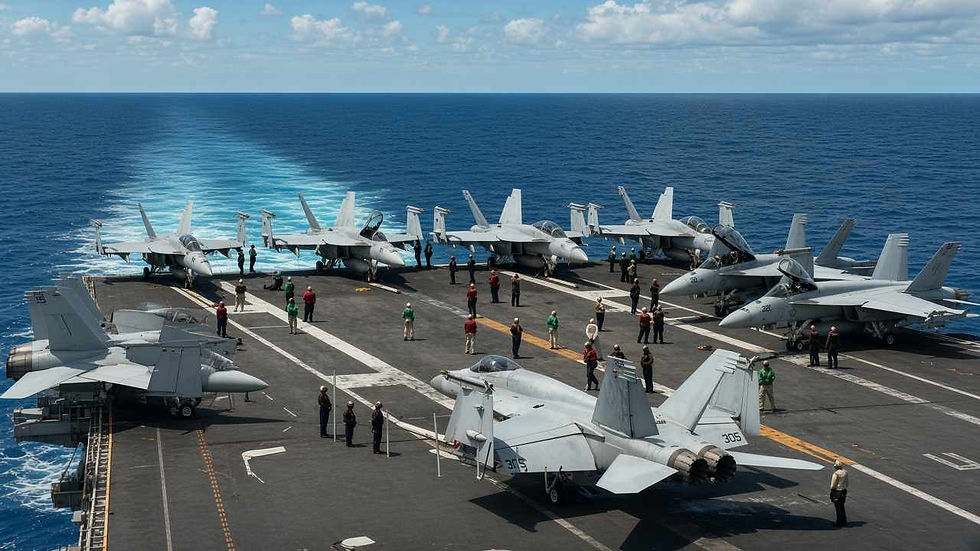
While negotiators continue discussions in Doha, the Strait of Hormuz remains under pressure from renewed security incidents, military deployments and uncertainty surrounding the implementation of the US-Iran Memorandum.
Several regional analysts argue that the challenge facing the Strait of Hormuz is no longer simply reopening commercial shipping. The greater challenge is restoring confidence.
Shipping lanes can reopen within days, but confidence among governments, insurers and commercial operators often takes months or even years to rebuild. In that sense, the Strait appears to be moving one step forward and two steps backwards.
Speaking to reporters before boarding Air Force One, Trump maintained that relations with Tehran were improving, saying the latest meetings in Doha had gone well and that progress was being made on preventing Iran from developing a nuclear weapon.
He also suggested that discussions surrounding shipping through the Strait of Hormuz and a lasting ceasefire were advancing, although he stopped short of outlining specific milestones or agreements reached.
"Iran has come a long way. We're getting along very well. Denuclearisation is moving along very well." — Donald Trump
The optimistic tone contrasted sharply with Tehran's public position. While Washington described the Doha process as constructive, Iran continued to insist that no high-level negotiations with the United States had been scheduled, explaining that technical delegations present in Qatar should not be interpreted as evidence of direct political engagement.
"We will not have any negotiation meetings at any level with the American side in the coming days." — Esmaeil Baghaei
That disconnect has become one of the defining characteristics of the current diplomatic effort. Public optimism from Washington now exists alongside official denials from Tehran, while military incidents continue to unfold across the Gulf faster than negotiators appear able to resolve them.
The result is an increasingly fragile diplomatic environment in which markets, governments and shipping companies are being forced to interpret not only what leaders say, but also what is happening on the water.
For energy markets, the implications are significant.
Although tanker traffic has largely recovered since the signing of the US-Iran Memorandum, confidence has not recovered at the same pace.
The return of commercial shipping through the Strait of Hormuz signals improving market stability, but lingering concerns over geopolitical risks continue to influence energy traders, shipping companies and investors.
FTN previously examined this recovery in detail in its analysis, “Strait of Hormuz Oil Flow Nears Pre-War Levels,” which explores how renewed shipping activity is reshaping expectations across global energy markets.
Markets initially welcomed the reopening of the Strait of Hormuz, but recent attacks on commercial shipping, renewed military deployments and conflicting diplomatic signals have reminded investors that restoring maritime traffic is far easier than restoring strategic certainty.
These unresolved tensions reflect a wider regional instability that extends beyond shipping lanes and energy markets. FTN’s analysis, “Middle East Conflict Escalation: Why the Region is Sliding Back to War,” examines how renewed strikes, fragile diplomatic arrangements and competing security interests are pushing the region toward another cycle of confrontation.
As a result, the central question facing the US-Iran Doha Talks is no longer confined to Iran's nuclear programme. It has expanded into a broader test of whether diplomacy can preserve stability in one of the world's most strategically important waterways before another crisis overtakes the negotiating process.

Comments