
Pentagon’s Three-Day Iran Strike Plan: Trump Weighs Escalation as Tehran Resists


Pentagon’s Three-Day Iran Strike Plan Raises Fears of Renewed War
The Pentagon’s three-day Iran strike plan has brought the conflict back to a critical point, exposing the widening gap between President Donald Trump’s public commitment to avoid renewed attacks before the November midterm elections and the military preparations underway should he change course.
According to reports citing US officials, the Pentagon has drawn up an option for a concentrated campaign lasting approximately three days, with potential targets including Iran’s missile and drone arsenal, energy facilities, military command centres and installations associated with the Islamic Revolutionary Guard Corps.
Senior national security officials, including Vice President J.D. Vance, reportedly discussed the options at Camp David. The plans were developed at Trump’s direction, but no final decision to launch the campaign has been announced. (Associated Press; Seoul Economic Daily)
The reported targets suggest that Washington is considering a renewed campaign designed to weaken Iran’s capacity to retaliate while placing additional pressure on the economic and military structures sustaining its resistance.
Energy facilities would extend the potential impact beyond the battlefield, while attacks on missile and drone infrastructure would seek to reduce the threat Iran poses to American forces, regional allies and shipping around the Persian Gulf.
Yet the preparations come at a time when Trump is publicly insisting that the United States will not resume military strikes before November 3. He has pointed to ongoing discussions with Tehran, while continuing to demand an agreement that addresses Washington’s concerns. The administration is therefore maintaining diplomatic contact even as the Pentagon prepares options for a possible return to large-scale combat. (Associated Press)
This is more than a contradiction in presidential messaging. It reflects the central problem confronting Washington after months of military confrontation: how to turn its conventional military advantage into a settlement that delivers its political objectives without dragging the United States into another prolonged campaign.
The immediate question is whether the strike plan is intended primarily to strengthen Trump’s negotiating position or whether the administration is preparing for a conflict that diplomacy has so far failed to resolve.
Trump Wants an Endgame While Keeping the Military Option Open
Trump’s approach rests on the belief that Iran can still be pressured into accepting an agreement without the United States having to resume a sustained bombing campaign. By maintaining the naval blockade, tightening sanctions and reinforcing American forces in the region, Washington is attempting to make the cost of continued resistance increasingly difficult for Tehran to bear.
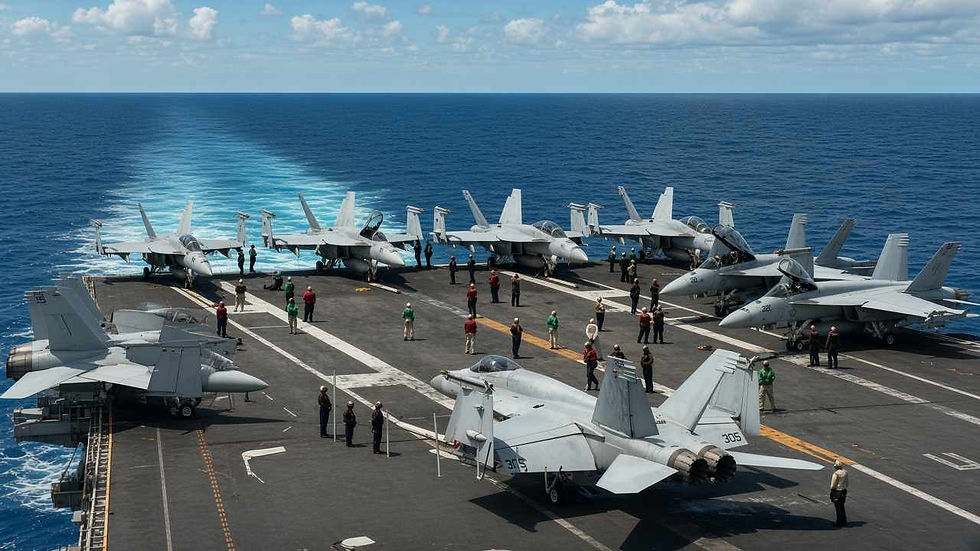
The deployment of additional naval forces reinforces that strategy. The USS Theodore Roosevelt carrier strike group has departed San Diego for the Middle East, while the United States has continued preparations to strengthen its regional military presence. The objective is to ensure that American forces can act quickly if Trump decides that negotiations have failed. (Al Jazeera)
Iran, however, has not accepted Washington’s terms, and the dispute over the Strait of Hormuz remains one of the main obstacles to a settlement.
In late September, Iranian Foreign Minister Abbas Araghchi outlined a seven-day roadmap for ending the confrontation. Tehran proposed that the United States lift its naval blockade, waive sanctions on Iranian oil exports, release frozen Iranian assets and agree to a regional ceasefire covering conflicts including Lebanon and Yemen. In return, Iran would reopen the Strait of Hormuz and resume nuclear negotiations within the proposed timetable. Trump rejected the proposal, leaving the two sides without a breakthrough. (Al Jazeera)
The disagreement is fundamentally about the sequence of concessions. Washington wants Iran to make meaningful commitments under continued pressure, while Tehran wants the blockade and sanctions eased before surrendering the leverage it holds over maritime traffic. Both sides believe that reducing their own leverage too early could leave them negotiating from a weaker position.
That is why diplomacy continues alongside military preparation without producing a durable settlement. Trump wants an endgame, but he also wants Iran to believe that rejecting his terms could bring another round of attacks.
Iran Has Survived, but Survival Is Not the Same as Victory
Iran has suffered serious military and economic damage, and its ability to continue resisting should not be mistaken for an absence of costs. Its missile and drone capabilities have been targeted, its economy remains under pressure, and the naval blockade has restricted its oil trade. The reported three-day strike option indicates that Washington believes further attacks could inflict additional damage.
But military damage and strategic defeat are not the same thing.
Iran’s survival matters because the conflict has become a contest over whether American military superiority can compel Tehran to accept Washington’s political demands. The United States possesses overwhelming conventional capabilities, but the existence of those capabilities does not automatically guarantee that its objectives can be achieved at an acceptable cost.
FTN examined this distinction in U.S. Iran War Losses: Did America Lose the Strategic War?. The central question extends beyond damaged equipment and military casualties to whether Washington has achieved the strategic results it sought when the conflict began.
Iran has continued to retaliate, preserve a degree of deterrence and use its position around Hormuz as bargaining leverage. These capabilities do not mean that Tehran has won the war, but they complicate any American attempt to translate battlefield advantages into complete political control.
If Iran remains capable of disrupting shipping, threatening regional targets and refusing terms it considers unacceptable, Washington must weigh the potential gains from another campaign against the risk of extending a conflict that has already imposed significant military, economic and diplomatic costs.
A renewed strike could damage Iran’s capabilities further. It could also provoke retaliation, disrupt energy supplies and make an eventual agreement harder to secure. The outcome would depend not only on what the United States destroys during three days of attacks, but also on how Iran responds and whether the military operation changes Tehran’s willingness to negotiate.
Hormuz Remains the Centre of the Bargaining Process
The Strait of Hormuz has become one of Iran’s most consequential sources of leverage because the consequences of disruption extend far beyond the two countries at war. The waterway connects major energy producers with international markets, making its security a concern for governments, shipping companies, insurers and energy consumers around the world.
That leverage is central to the dispute over the terms of a ceasefire. Washington wants predictable maritime access and the removal of threats to commercial shipping. Tehran wants the blockade lifted, sanctions eased and guarantees against renewed attacks before giving up its strongest bargaining instrument.
FTN explored this confrontation in Strait of Hormuz Deal: Iran Raises the Stakes, examining how Iran’s conditions for reopening the waterway have turned a military confrontation into a broader negotiation over sanctions, frozen assets, regional security and the future management of maritime traffic.
The Pentagon’s three-day Iran strike plan must be understood against this background. Attacking Iran’s missile and drone arsenal could reduce some of its military options, but it would not necessarily resolve the political disagreement over Hormuz. Strikes on energy facilities could also deepen the economic consequences of the conflict without guaranteeing that Tehran would accept Washington’s terms.
The United States therefore faces a difficult calculation. It can increase military pressure in the hope that Iran will concede, but the more the conflict threatens regional energy infrastructure and shipping, the greater the risk that escalation will carry consequences for the global economy as well as for Iran.
In the ongoing Iran War, the United States has reportedly lost or sustained damage to 81 aircraft, with estimated replacement and repair costs ranging from $1.9 billion to $3.3 billion. The losses include 12 F-15s, 1 F-35, 2 A-10 jets, 7 KC-135 refueling planes, 1 E-3 Sentry, 2 MC-130J special operations aircraft, 45 MQ-9 UAVs, 1 Apache helicopter, 1 MQ-4 and 3 MQ-1 drones, 1 rescue helicopter, 4 AH-6 helicopters, and 1 Sea Hawk. This breakdown highlights the significant aerial toll of the conflict. Credit: RT.
Russia and China Are Watching the Same Battlefield Differently
Iran’s position also matters to powers beyond the Middle East. Russia continues to present itself as a diplomatic actor in the wider confrontation, while China has significant interests in the energy flows and commercial networks affected by instability around Hormuz.
For Moscow, the conflict creates opportunities to reinforce its diplomatic relevance and maintain relationships with Tehran. For Beijing, the consequences reach into energy security, trade and the stability of the wider international system. Neither country determines Iran’s decisions, but both operate in a geopolitical environment where prolonged US engagement in the Middle East has implications beyond the immediate battlefield.
FTN’s Iran War: The Long Game for Middle East Dominance examines how the confrontation has evolved into a contest over endurance, regional influence and the systems that sustain global power. Energy, shipping, sanctions and strategic partnerships are not secondary consequences of the conflict. They are part of the environment in which each side calculates its next move.
A new US strike campaign could weaken Iran’s military capabilities while also creating fresh pressure on regional energy supplies and diplomatic relationships. Russia and China would then have to assess how the next phase affects their own interests, including their relationships with Tehran and the broader balance of power.
The longer the confrontation continues, the more difficult it becomes to isolate the consequences within Iran’s borders.
The American Public Is Becoming Part of the Strategic Equation
Washington’s calculations are also shaped by domestic political pressure. An AP-NORC poll conducted September 24–28 among 2,140 US adults found that 71% disapproved of Trump’s handling of Iran, while 69% said the war had not been worth fighting. The survey reported a margin of sampling error of plus or minus 2.9 percentage points. (AP-NORC)
Those figures do not determine what Trump will do, but they provide important context for his public commitment to avoid renewed attacks before the November 3 midterms.
The administration must weigh the military arguments for further strikes against the political consequences of prolonging an unpopular conflict, particularly when energy disruption and higher prices affect American households.
A three-day campaign might be presented as a limited operation rather than a return to open-ended war. Yet the duration of the initial strikes would not determine the duration of the consequences. Iran could retaliate against American forces or regional allies, and attacks on energy infrastructure could prolong instability even after the bombing stopped.
That is the risk of treating a short campaign as a self-contained military solution. Three days may describe the planned period of concentrated attacks, but it cannot guarantee that the conflict will end when those attacks are over.
The Next Phase May Be Decided at the Negotiating Table
The Pentagon’s three-day Iran strike plan shows that Washington is preparing for renewed combat even as Trump publicly holds to a diplomatic timetable. The plan reportedly targets the capabilities that could allow Iran to continue resisting, but it does not resolve the underlying dispute over sanctions, Hormuz, regional security or the future of Iran’s nuclear programme.
The three FTN articles approach different sides of that problem. Strait of Hormuz Deal: Iran Raises the Stakes explains why the waterway has become central to negotiations. U.S. Iran War Losses: Did America Lose the Strategic War? examines the gap between military superiority and strategic results. Iran War: The Long Game for Middle East Dominance places both within the broader competition involving energy, trade, Russia, China and the future balance of power in the Middle East.
The central question is whether renewed attacks would change the terms of that competition or simply deepen its costs. The United States retains formidable military power, while Iran faces severe economic and military pressure. Yet neither side has secured an uncontested political outcome, and another round of strikes could either force new concessions or trigger another cycle of retaliation.
For now, the Pentagon has prepared an option, not a confirmed order to attack. Trump has publicly ruled out strikes before the midterms, while the military continues to prepare for what could follow if diplomacy fails.
The distinction matters because the next phase of the US war on Iran will not be decided solely by the damage inflicted during a three-day campaign.
It will depend on whether Washington can turn military pressure into an agreement, whether Tehran believes it can continue to resist, and whether either side is prepared to concede enough to prevent another escalation.


Comments